Under a Gravid Sky, a prequel set in 1747, The Blood and the Barley, set in 1780, Where the Heart beats Strongest, set in 1769
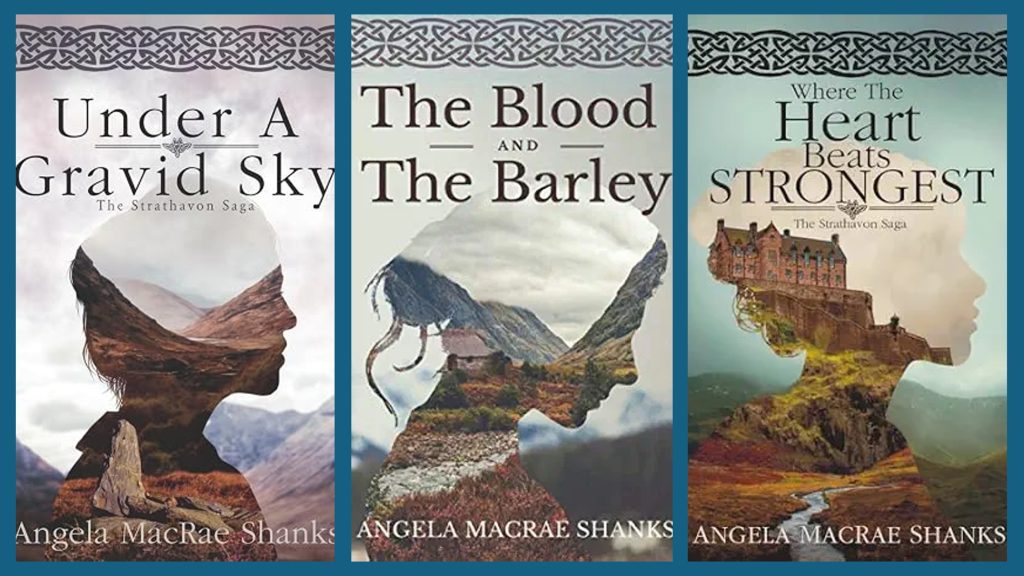
I enjoy Scottish history and so in the mid 2020s I was intrigued by these novels set in the remote Strathavon Glen (a real place) of Moray/River Spey in Northeast Scotland – not the most common setting for Scottish events in comparison with the Western Highlands and Islands, or indeed the Borders. Yet the date of the novels catches the eye immediately –1747, the aftermath of the battle of Culloden. The triumphant Redcoats are sent to occupy the area and ultimately eradicate the highlanders’ culture and way of life. The fact that the writer was born and bred in that place, going back generations, and still lives there, adds a great deal to the authenticity of the writing, description, characters and stories, for she has heard them before, directly from those around her.
Into this beautiful but tense landscape of fear, danger, suspicion and betrayal, the writer introduces a small group of powerfully drawn central characters who will show us their way of life: a life under threat. At its heart is the love between Morven and Jamie. Through their portrayal, we learn of the twists and conflict that cannot easily be overcome. Morven is gentle and has learnt a great deal about nature, plants in particular, and is a gifted healer. These skills she has developed from another fascinating central character, Rowena. She in turn has a kinsman, Duncan, a whisky smuggler. Thus the writer spreads before us the ways and customs of the highlanders; their codes of honour and dark secrets; their loves and hopes; their day to day means of survival, as rents rise and new taxes and laws are imposed. Oh, and there are very satisfying villains. Gradually, the whole gamut of society becomes involved, opinions formed and judgements made. People jostle to find a place for themselves and adapt accordingly. First and foremost, however, it is the lives of the highlanders that are so compelling. The writer’s detailed knowledge is impressive as no item is too trivial to be woven into the picture, from the food they ate, the clothes they wore to church, their education and language. (There is a list of words ‘In the Scots’ tongue’ at the end of each novel.) The ties of loyalty and kinship are explored. In this land touched by myth, magic and superstition, people are struggling to survive.
Each book can be read quite satisfactorily as an independent novel though characters, plot and events are all further developed in each one. Although she had always envisaged a trilogy, The Blood and the Barley was Angela MacRae Shanks’ first published novel and it was greeted with some acclaim. There are flaws, of course. In conveying so much to the reader it can feel at times as if she is trying to be all things to all people, with too large a nod to commercial interest. This is not a sophisticated literary work as such, but its power stems from her authentic local knowledge so that the beauty of the glen and the lives of its community are strikingly conveyed. Add some memorable characters and clever, exciting plotting and we have a saga that, if it was not on your radar when it was first published, I suggest is worth a look.